in Oil, Gas and Petrochemical Industries Metallurgy, service life, leakage rate, safety (SIL) and cost–benefit (TCO) over a 10‑year period
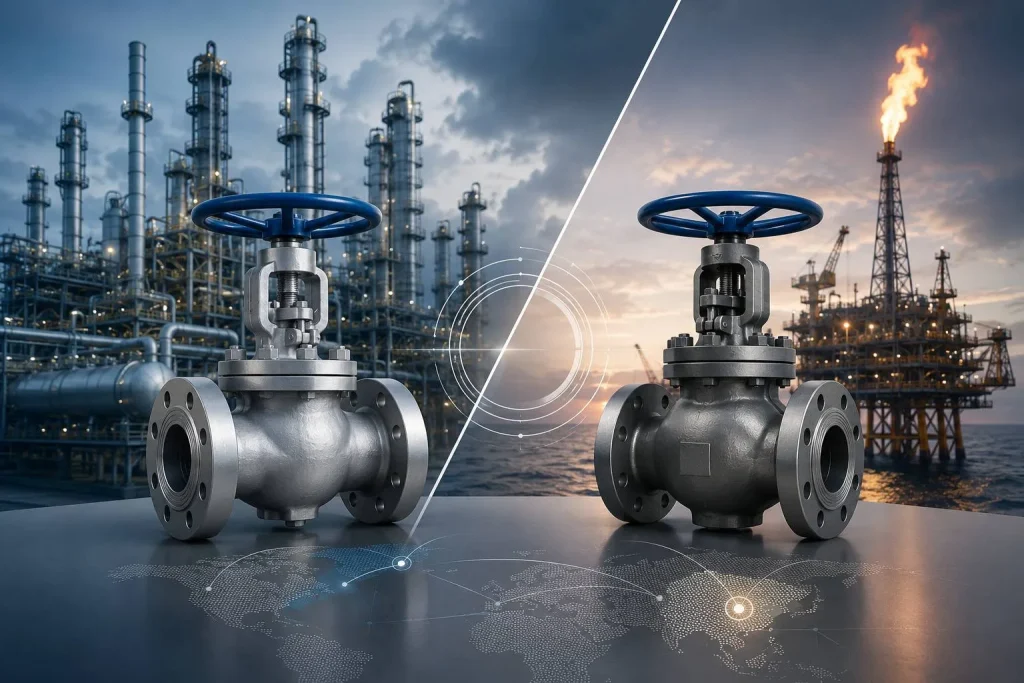
In sensitive oil, gas and petrochemical environments, the correct selection of industrial valves (valves) directly affects safety, reliability and process continuity. Today, leading European and American brands coexist with rapidly advanced Asian manufacturers, making a comprehensive technical comparison an essential requirement for owners and operators.
Metallurgy and design standards Leading European and American brands typically design valve bodies, trim and seats in strict compliance with API, ASME and ISO standards. This includes using corrosion‑resistant alloys (e.g., AISI‑based stainless steels, high‑alloy steels for H₂S and hydrogen service) in all wetted parts exposed to aggressive fluids.
Many top Asian manufacturers also declare compliance with API 6D, API 598, ISO 5208 and ISO 9001; however, additional certificates related to continuous sampling, microstructural analysis and long‑term corrosion testing are less common in their lower‑tier product lines.
Operational lifetime under high pressure and temperature Field reports from oil and gas facilities indicate that valves from leading European brands often achieve service lives of 15–20 years under proper maintenance, even in high‑pressure and high‑temperature duties.
Among Asian manufacturers, premium brands can approach similar lifetimes, but in the lower‑cost segment, average service life is often limited to 7–10 years, especially in critical upstream and pipeline applications.
Leakage rate and standard test classes One of the most critical comparison points is leakage performance under standard test conditions.
API 598 and ISO 5208 define precise leakage acceptance criteria for on–off and regulating valves at different pressure and temperature levels.
Premium European brands typically achieve Class V or Class VI tight shutoff (virtual zero leakage), while many Asian valves are certified only down to Class III or IV, which implies higher allowable leakage.
In petrochemical and LNG processes, this difference directly affects fugitive emissions, product losses and energy efficiency.
Operational safety and SIL standards For control and automated valves, Safety Integrity Level (SIL), defined in IEC 61508 and IEC 61511, is a key criterion.
Leading European manufacturers provide valves and actuators with documented SIL 2 or SIL 3 certification, including detailed Failure Modes and Hazard Analysis reports for owner review.
Among Asian suppliers, only a few top brands (often in partnership with European OEMs) can deliver full SIL‑certified solutions; many mid‑ and low‑cost brands lack dedicated SIL qualification altogether.
This is critical for safety‑critical systems such as HIPPS, ESD and high‑pressure blowdown systems.
Cost–benefit analysis: Total Cost of Ownership (TCO) over 10 years When evaluating realistic project economics, Total Cost of Ownership (TCO) over the asset life is far more meaningful than initial purchase price.
European valves:
Higher initial cost (often 1.5–2.5× comparable Asian products).
Longer service life, fewer unplanned replacements, lower leakage and higher energy efficiency.
Premium Asian valves:
Lower initial investment, but potentially higher maintenance frequency, availability issues and earlier replacements.
Over a 10‑year horizon, European valves usually show better TCO for harsh applications (heavy crude, sour gas, high‑risk environments), while high‑quality Asian valves can be cost‑effective for non‑critical, budget‑sensitive circuits.
Karaberasam Parsian as a technical reference Karaberasam Parsian can serve project owners as a central technical reference by providing:
A standardized technical–economic comparison table (API/ISO/SIL/TCO) for European and Asian valve brands.
Project‑specific recommendations balancing upfront cost, safety and life‑cycle risk.
Optional compliance reports for each project, to be submitted to owners and EPC contractors as formal technical documentation.